So, you're dreaming of owning a sun-drenched riad in Marrakech or a breezy seaside apartment in Essaouira? It’s an exciting thought, and for good reason. What many people don't realise is how straightforward the process can be for foreigners. You can own freehold property, known locally as 'Titre Foncier', in most areas without any major hurdles, making that Moroccan dream home a very real possibility.
Understanding the Moroccan Property Market
Deciding to acheter immobilier au maroc opens up a world of incredible options, from the vibrant, maze-like medinas to quiet coastal towns. The market here is incredibly diverse, offering something for just about every taste and investment goal. Whether you're picturing a traditional home brimming with character or a sleek, modern flat, getting a feel for the landscape is the essential first step.
Morocco's appeal is powerful, mixing a deep cultural heritage with a surprisingly modern, forward-looking economy. This energy is mirrored in its real estate market, drawing in everyone from lifestyle buyers seeking a unique escape to sharp investors looking for solid returns.
What's Fuelling the Market?
It’s not just about beautiful properties; the economics behind Moroccan real estate are compelling. I’ve seen several key factors consistently drive its appeal over the years:
- A Booming Tourism Sector: The steady flow of tourists creates a constant demand for short-term rentals, especially in hotspots like Marrakech, Taghazout, and Essaouira. This can mean a healthy rental yield if you're looking for an investment property.
- A Stable Economic Foundation: Morocco is known for its stable economy, which offers a secure and reassuring environment for foreign buyers to invest their capital.
- Major Infrastructure Upgrades: The government is pouring money into infrastructure—think high-speed trains and modernised ports. These projects are boosting connectivity and, as a result, property values across the country.
Looking ahead, the broader Moroccan real estate market is poised for strong growth from 2025 through 2030, with some of the best opportunities in premium residential land plots. The country is set to benefit from huge investments in transportation and tourism, not to mention big strides in green energy. All of this works together to drive up real estate demand and property values. You can find more detailed analysis on Morocco's real estate investment climate to dig deeper into this trend.
Common Moroccan Property Types at a Glance
To make a smart decision, you first need to know what’s out there. Each property type in Morocco comes with its own unique lifestyle and investment potential.
My Two Cents: Don't get fixated on just one property type from the get-go. I always advise clients to visit a mix of riads, apartments, and villas. It gives you a much clearer sense of what genuinely fits your vision and, just as importantly, your budget. It’s funny how often the property you fall in love with is the one you least expected.
This quick comparison should help you see which property type might best suit your goals and lifestyle.
| Property Type | Best For | Typical Location | Key Consideration |
|---|---|---|---|
| Riad | Authentic cultural immersion, boutique guesthouses | Historic Medinas (Marrakech, Fès) | Renovation potential and high rental demand |
| Apartment | Modern living, lower maintenance, rental income | Urban centres (Casablanca, Rabat) | Proximity to amenities and transport links |
| Villa | Luxury living, family homes, privacy, space | Gated communities, coastal areas | Higher maintenance costs and security features |
| Dar | Smaller traditional house, budget-friendly option | Medinas and older neighbourhoods | Often requires modernisation; less grand than a Riad |
Ultimately, choosing to acheter immobilier au maroc is as much a heart-led lifestyle decision as it is a financial one. By getting comfortable with the market’s nuances and the different property styles, you’re putting yourself in a great position to find a home that brings you joy and delivers long-term value. This foundational knowledge is your bedrock before you dive into the more technical legal and financial steps.
Navigating Morocco's Legal and Financial Steps
Buying property in Morocco is an exciting journey, but it's one where knowing the local rules of the game is absolutely critical. Getting the legal and financial steps right from the outset makes all the difference between a smooth transaction and a stressful one. From my experience, taking your time here pays off massively down the line.
The entire process revolves around a key professional: the 'notaire' (notary). It's important to understand they aren't like a solicitor who works just for you. A Moroccan notaire is a government-appointed official who acts as a neutral party, ensuring the deal is fair, transparent, and legally sound for both buyer and seller. They're your go-to for checking documents, drafting the contracts, and making sure the property is registered correctly.
This image offers a great snapshot of the kind of economic dynamism you see in major hubs like Casablanca, which directly influences property trends and investment potential.
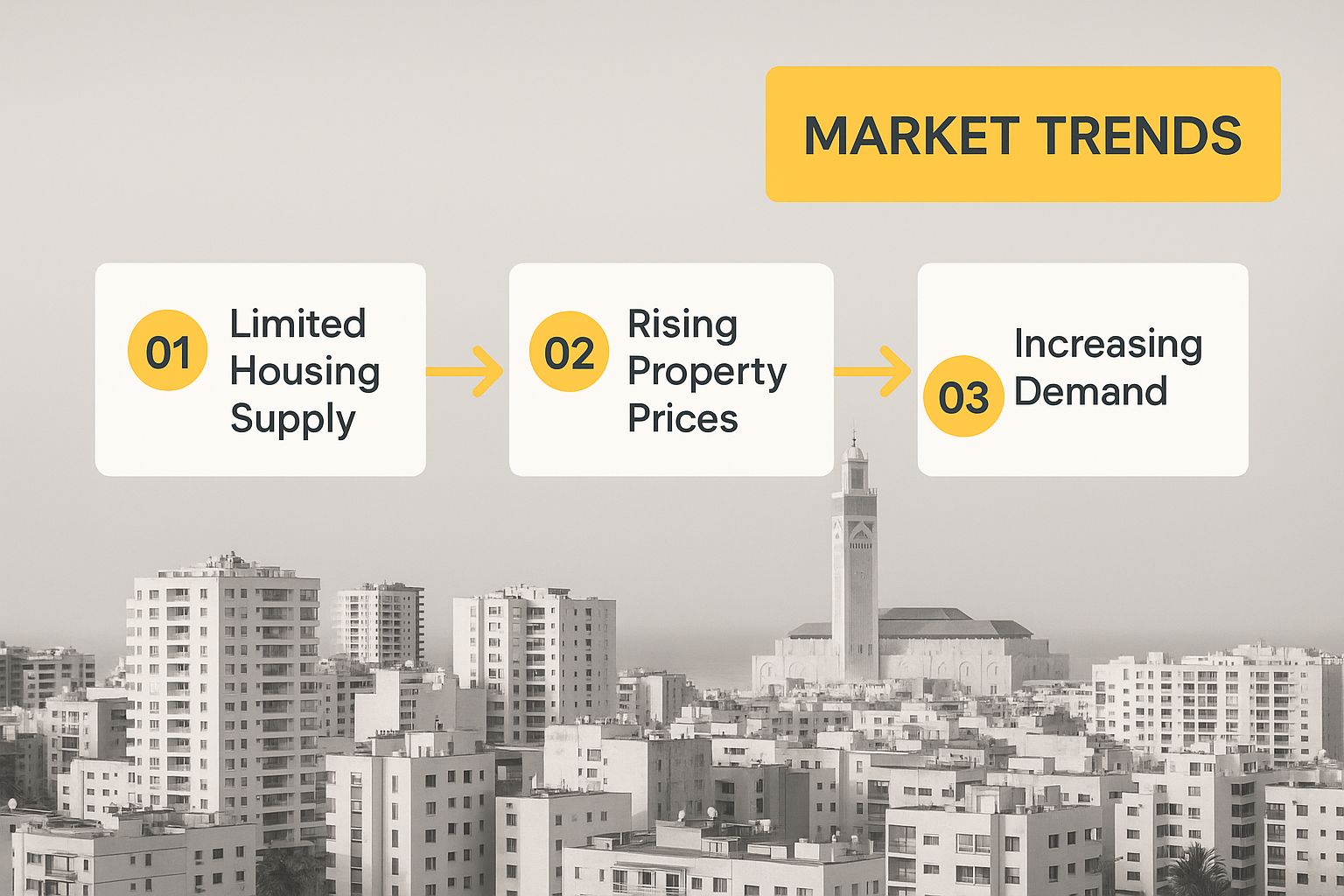
It’s this blend of modern growth and established culture that keeps the market here so vibrant.
First Things First: Your Convertible Dirham Account
Before you can even think about making an offer, there's a crucial first step every foreign buyer must take: opening a convertible Moroccan Dirham (MAD) bank account. This isn't optional; it's a strict requirement from the Office des Changes, Morocco's foreign exchange authority.
So, why is this account so vital?
It's specifically designed to let you transfer your money—be it Pounds, Euros, or Dollars—into Morocco and convert it to Dirhams for the purchase.
More importantly, it creates an official paper trail. This is the proof you'll need later if you decide to sell. It shows the money originally came from outside Morocco, giving you the legal right to repatriate your sale proceeds and any rental income back home without getting tangled in red tape.
My Advice: I always tell clients to think of this account as their financial passport for Moroccan real estate. Without it, you simply can't move your funds in and out of the country for a property deal. Get this process started the moment you get serious about buying, as it can take a couple of weeks.
The Two Key Documents You'll Sign
Your path to ownership is paved with two critical legal documents, both drawn up by your notaire. Getting your head around these will give you a lot of confidence during the transaction.
-
The Preliminary Sales Agreement ('Compromis de Vente'): This is the first binding contract that officially locks in the deal. It details everything from the property's description and price to any special conditions (clauses suspensives), like securing a mortgage. When you sign the compromis de vente, you'll pay a deposit—typically 10% of the purchase price—which the notaire holds securely in an escrow account.
-
The Final Deed of Sale ('Acte de Vente'): Once all the conditions are met and the full payment is with the notaire, this is the final document. Signing the acte de vente is the moment you officially become the owner. The notaire then takes this deed and registers it with the land registry.
If you want to dig deeper into the step-by-step process, our other guide explains how to buy property in Morocco easily.
Securing Your Title and Budgeting for Costs
The absolute gold standard for property ownership in Morocco is the 'Titre Foncier'. This is the definitive title deed, logged with the national land registry (ANCFCC), which guarantees your ownership beyond any doubt. It clearly maps out the property's boundaries and any rights or restrictions tied to it. A huge part of the notaire's job is to perform a thorough search to ensure the property has a clean Titre Foncier before you commit.
Finally, remember the sale price isn't the final price. You need to budget for the associated closing costs. A good rule of thumb is to set aside an extra 7-10% of the purchase price to cover all the necessary fees and taxes.
What does this cover?
- Registration Taxes: This is the largest chunk, usually about 4% of the sale price.
- Notary Fees: This is legally set at around 1% of the price, plus some smaller administrative charges.
- Land Registry Fees (ANCFCC): A fee for registering the new title in your name.
- Other Minor Fees: Small costs for stamps and official paperwork.
Your notaire will give you a clear, itemised breakdown of all these costs well ahead of the final signing. Budgeting for them properly means no nasty surprises, just the satisfaction of a successful purchase.
The Search and Negotiation Process
Finding your perfect Moroccan property is an adventure. It's a hunt that starts with excitement and online browsing, but successfully landing the right home—especially when you acheter immobilier au maroc—requires a smart mix of digital savvy and crucial, on-the-ground knowledge.
Most people start their search online, but it's vital to see those listings as mere introductions. A great local agent, or agent immobilier, is your best ally here. They often have access to off-market properties and possess an uncanny ability to sift through the noise, matching your wish list to real-world options and saving you countless hours.
But there’s one golden rule that applies whether you're working with an agent or going it alone: you absolutely must visit properties in person. Photos can paint a very different picture. That idyllic, quiet courtyard could be right next to a noisy workshop, a detail conveniently omitted online. You have to walk through a space to truly appreciate its layout, the quality of light, and the genuine feel of the neighbourhood.
Vetting Listings and Properties in Person
Once you’re on-site for a viewing, it’s time to switch from dreamer to detective. Look past the fresh paint and strategically placed furniture to see what’s really going on.
Here’s what I always tell my clients to focus on:
- Look for Damp: Check for tell-tale water stains on ceilings and walls. Does it smell musty? This is especially common in older riads and can be a sign of bigger issues.
- Check the Structure: Scan for major cracks in the walls, floors, or foundation. Minor settling cracks are one thing, but large, sprawling ones can signal serious structural problems.
- Assess the Neighbourhood at Different Times: A street that’s peaceful at 11 AM could transform into a chaotic, noisy hub during the evening rush or on market days. Visit more than once.
- Test the Utilities: Don’t be shy. Turn on taps to check the water pressure, flick the light switches, and ask pointed questions about the age and condition of the plumbing and electrical systems.
This hands-on inspection is your best line of defence against expensive, hidden surprises down the road. It’s what separates a dream home purchase from accidentally buying a massive renovation project.
The Art of Moroccan Negotiation
So, you’ve found the one. Now comes the negotiation. This is where a deep appreciation for local culture really pays off. While haggling is woven into the fabric of Moroccan commerce, real estate negotiation is far more nuanced and formal than bargaining in the souk.
Your opening offer needs to be grounded in reality. Base it on your research of what similar properties in the area have recently sold for, not on a whim. Throwing out a ridiculously low number is often seen as disrespectful and can kill the deal before it even begins. A good rule of thumb is to start your offer 5-15% below the asking price, adjusted based on the property's condition and how long it's been listed.
Expert Insight: Think of negotiation as a patient dance, not a battle. It's almost never a one-offer-and-done scenario. Expect a counteroffer. Your ability to stay calm, remain polite, and logically justify your price—for example, "The boiler is 15 years old and will need replacing"—will earn respect and get you much closer to a fair agreement.
Once you’ve settled on a price verbally, it’s time to make it official in the compromis de vente (the preliminary sales agreement). This is your moment to insert crucial protective clauses, known as clauses suspensives.
These are non-negotiable safety nets. Common ones include:
- A Financing Clause: This makes the sale dependent on you securing your mortgage. If the bank says no, you can walk away.
- An Inspection Clause: This gives you the right to bring in a professional for a structural survey and back out if major defects are discovered.
- A Clear Title Clause: This ensures the sale only moves forward after the notaire confirms the property has a clean and unencumbered title, the Titre Foncier.
These clauses provide a legal exit ramp if something unexpected pops up, protecting you and your deposit. By navigating the negotiation with a well-researched strategy, you set yourself up for a secure and successful purchase. For those drawn to particularly sought-after areas, it helps to understand why Marrakech is the perfect location for your holiday home and how its popularity can influence the entire buying journey.
Exploring Investment Hotspots Like Marrakech
While Morocco has plenty of attractive property markets, Marrakech consistently shines as a top destination for international investors. The "Red City" is far more than just a cultural jewel; it's a buzzing investment hub, particularly if you’re eyeing the profitable short-term rental scene. The potential returns here aren't just guesses—they're backed by solid, year-on-year data.
For anyone looking to acheter immobilier au maroc with an eye on generating income, Marrakech makes an incredibly strong argument. The city's worldwide fame creates a constant high demand for holiday lets, from traditional riads hidden in the ancient Medina to sleek flats in the newer parts of town. This is the engine that keeps occupancy rates high and rental yields impressive for owners.
Decoding the Rental Market Numbers
Before you get swept up in the romance of owning a riad, it’s crucial to look at the hard data. Making a strategic investment, rather than just an emotional one, starts with the numbers. And in Marrakech's short-term rental market, those numbers tell a very compelling story.
This data-driven view lets you forecast potential revenue and truly understand the return on investment you could be looking at. For instance, the performance of rental properties in the city is remarkably strong. A typical Airbnb listing in Marrakech is booked for an average of 234 nights a year, translating to a 64% occupancy rate.
This high demand supports an average daily rate (ADR) of around MAD 799 (roughly $79 USD). Do the maths, and you'll find the average annual revenue per Airbnb rental in Marrakech hits about MAD 179,000 (or $17,000 USD). You can dig deeper into Marrakech's impressive rental market data on Airbtics.com.
Expert Takeaway: These figures are more than just stats; they're proof of a mature, thriving market. An occupancy rate hovering above 60% points to year-round demand. It means your property isn't just making money during peak tourist season but can provide a steady cash flow throughout the year.
This level of performance really cements Marrakech’s status as a premier buy-to-let location in North Africa.
Neighbourhood Showdown: Medina vs. Gueliz
Choosing the right neighbourhood is just as important as picking the right property. Different areas attract different crowds, so your choice will heavily influence your rental success. Two of the most popular yet distinct districts for investors are the historic Medina and the modern Gueliz.
Let's break down how they compare to help you decide which one fits your investment goals.
| Feature | The Medina | Gueliz |
|---|---|---|
| Atmosphere | Historic, authentic, with winding, car-free alleys. | Modern, cosmopolitan, with wide boulevards. |
| Property Type | Traditional Riads and Dars. | Modern apartments and penthouses. |
| Ideal Renter | Tourists seeking a cultural, immersive experience. | Visitors wanting modern comforts and conveniences. |
| Pros | High rental demand for unique, authentic stays. | Easy access, modern amenities, close to shops. |
| Cons | Can be noisy; access with luggage can be tricky. | Lacks the traditional charm of the old city. |
Ultimately, your decision comes down to your target audience. A beautifully restored riad in the Medina will capture the hearts of travellers looking for an authentic Moroccan adventure. On the other hand, a stylish apartment in Gueliz with a lift and a balcony will appeal to those who value modern convenience and a more European vibe. You can learn more about what makes different areas special by checking out our guide on the top reasons to invest in Marrakech real estate in 2024.
By carefully analysing the market data and getting to know the unique personality of each neighbourhood, you’ll be in a much stronger position to make a smart and profitable investment when you decide to acheter immobilier au maroc.
The Rise of Sustainable Properties
When you start looking to acheter immobilier au Maroc, you’ll quickly notice a powerful trend reshaping the market, one that no savvy investor can afford to overlook. I’m talking about the significant shift towards sustainability and eco-friendly construction. It’s a movement gaining serious momentum across the country, particularly in progressive hubs like Marrakech.
This isn't just about feeling good about your purchase; it's a shrewd, future-proof investment strategy. We're seeing a clear increase in demand for green properties, driven by both a rising environmental consciousness and a solid understanding of the long-term financial perks. Put simply, properties designed to be kinder to the planet are also much kinder to your wallet.
What “Green Construction” Really Means in Morocco
In the Moroccan context, green construction is a very practical affair. It’s all about efficiency, smart resource management, and a deep respect for the local environment. It goes far beyond aesthetics, embedding core principles that shrink a property’s environmental footprint while making it a better place to live.
What’s fascinating is how it blends modern tech with age-old wisdom. Developers are getting creative, integrating features that harness Morocco’s most abundant natural resources—sunshine and a unique climate—to build homes that are not only beautiful but also incredibly efficient to run. This focus on sustainability is fast becoming a key selling point in the premium property market.
A major benchmark for this shift is the adoption of international green building standards. Many new housing projects are now designed to comply with frameworks like Haute Qualité Environnementale (HQE), which puts energy efficiency and minimal environmental impact front and centre. You'll commonly find features like solar panels for water heating, energy-saving LED lighting, and the use of locally sourced materials. Advanced rainwater harvesting systems and xeriscaping—creating stunning, drought-resistant gardens—are also becoming standard. To see how this is playing out in new developments, you can explore more insights on eco-friendly homes in Marrakech.
The Real-World Benefits for You
Choosing a sustainable property delivers concrete advantages that extend well beyond environmental brownie points. These benefits hit your bottom line and boost the long-term strength of your investment, giving you a clear edge.
The most immediate win? A noticeable drop in your monthly utility bills. Homes fitted with solar water heaters, high-performance insulation, and water-saving fixtures can slash energy and water consumption. Over the life of the property, these savings add up to a significant return on your initial outlay.
Investor Insight: From my experience, sustainable properties consistently command higher resale values and attract a premium rental audience. As global awareness around climate change sharpens, people are increasingly willing to pay more for homes with lower running costs and a smaller carbon footprint. This makes a green property a more resilient and sought-after asset in a crowded market.
Let's break down a few of these features and their direct impact:
- Solar Panels for Water Heating: This is a no-brainer in Morocco and incredibly effective. It dramatically cuts down on the electricity or gas needed for hot water, which is typically one of the biggest household energy drains.
- Rainwater Harvesting Systems: These systems capture and store rainwater for use in gardens and for other non-drinking needs. In a country where water conservation is paramount, this reduces your reliance on the municipal supply.
- Local and Sustainable Materials: Using materials like locally sourced stone, wood, and traditional tadelakt plaster does more than just support the local economy. It cuts the carbon footprint tied to transporting materials from far away, and these materials are perfectly adapted to thrive in the Moroccan climate.
When you choose to acheter immobilier au Maroc with sustainability in mind, you aren’t just buying a house. You're investing in a home that is built for tomorrow—an asset that reflects modern values, delivers superior financial performance, and provides a healthier, more comfortable place to live.
Your Top Questions About Buying Property in Morocco
Jumping into a new property market always brings up questions. It's completely normal. Even after you've got the main steps down for how to acheter immobilier au Maroc, you’ll likely have a few specific things on your mind.
This section is here to give you straightforward answers to the most common queries we get from international buyers. Think of it as a final Q&A to clear up any lingering doubts before you move forward with confidence.
Are There Any Restrictions on Foreign Property Ownership?
This is the big one, and thankfully, the answer is mostly good news. As a foreign national, you can absolutely purchase and own freehold property, known as 'Titre Foncier', in most of Morocco's urban centres and designated tourist areas. In these zones, you have the same rights as any Moroccan citizen.
There is one major exception to keep in mind, however: agricultural land. The purchase of land zoned for agriculture is reserved strictly for Moroccan citizens. This isn't a flexible rule.
For this reason, it’s absolutely critical to confirm the official zoning and title status of any property you’re considering. Your notaire will do this as part of their due diligence, but it’s something you should be aware of from the very beginning.
What Are the Typical Closing Costs I Should Budget For?
The sticker price is just the starting point. To avoid any unwelcome surprises when it's time to sign, you must factor in the closing costs.
A solid rule of thumb is to set aside an extra 7-10% of the property's purchase price to cover all the associated fees and taxes. This lump sum is paid to the notaire when you settle the final property payment.
So, where does that 7-10% go? Here's the breakdown:
- Property Registration Tax ('Droits d'Enregistrement'): This is the largest chunk, usually around 4% of the purchase price.
- Notary Fees ('Honoraires du Notaire'): The notary’s fee is set by law at roughly 1% of the property value, plus VAT.
- Land Registry Fees ('Conservation Foncière'): A 1.5% fee is charged by the land registry (ANCFCC) to officially register the new title deed in your name.
- Miscellaneous Admin Charges: This covers smaller costs for official stamps, certificates, and other paperwork, typically adding up to a few thousand dirhams.
Your notaire is legally obliged to give you a detailed, itemised breakdown of these costs—a document called a décompte—long before you sign the final deed.
Expert Tip: Don't hesitate to ask your notary for an estimated cost breakdown early on, even when you're just signing the preliminary sales agreement (compromis de vente). It helps you plan your finances with total clarity and no last-minute shocks.
Can I Get a Mortgage From a Moroccan Bank as a Non-Resident?
Yes, you can. It is entirely possible for non-residents to get a mortgage from a Moroccan bank to finance their purchase, and several major banks have products designed for international buyers.
That said, you should be prepared for a more rigorous process than you might be used to back home.
Moroccan banks will almost always ask for a much larger down payment from a non-resident, often in the 40-50% range. They also conduct a deep dive into your financial health, scrutinising your international income, job stability, and credit history.
Frankly, because the process involves a mountain of paperwork and can be quite complex, many foreign buyers find it easier to arrange financing in their home country or simply purchase with cash if they can.
Do I Need to Be Physically Present for the Entire Process?
While we can't recommend it enough—you should absolutely visit Morocco to see properties with your own eyes before committing—you don't have to be here for every single step. We know that life and work can make it tough to be in-country for the whole transaction.
The Moroccan legal system has a perfect solution: the Power of Attorney ('procuration').
You can grant a Power of Attorney to a trusted representative, which is most often your lawyer or the notaire handling the sale. This empowers them to sign the preliminary contract or the final deed (acte de vente) and manage other formalities on your behalf. This is a formal legal document that must be drafted properly and often needs to be legalised or apostilled, depending on where you sign it.
At Rich Lion Properties, we're here to make your dream of owning a home in Morocco a reality. Our expert team offers end-to-end guidance, ensuring every step is smooth and transparent, from the first viewing to the final signature. Ready to start your journey? Explore our exclusive listings and expert services at Rich Lion Properties.