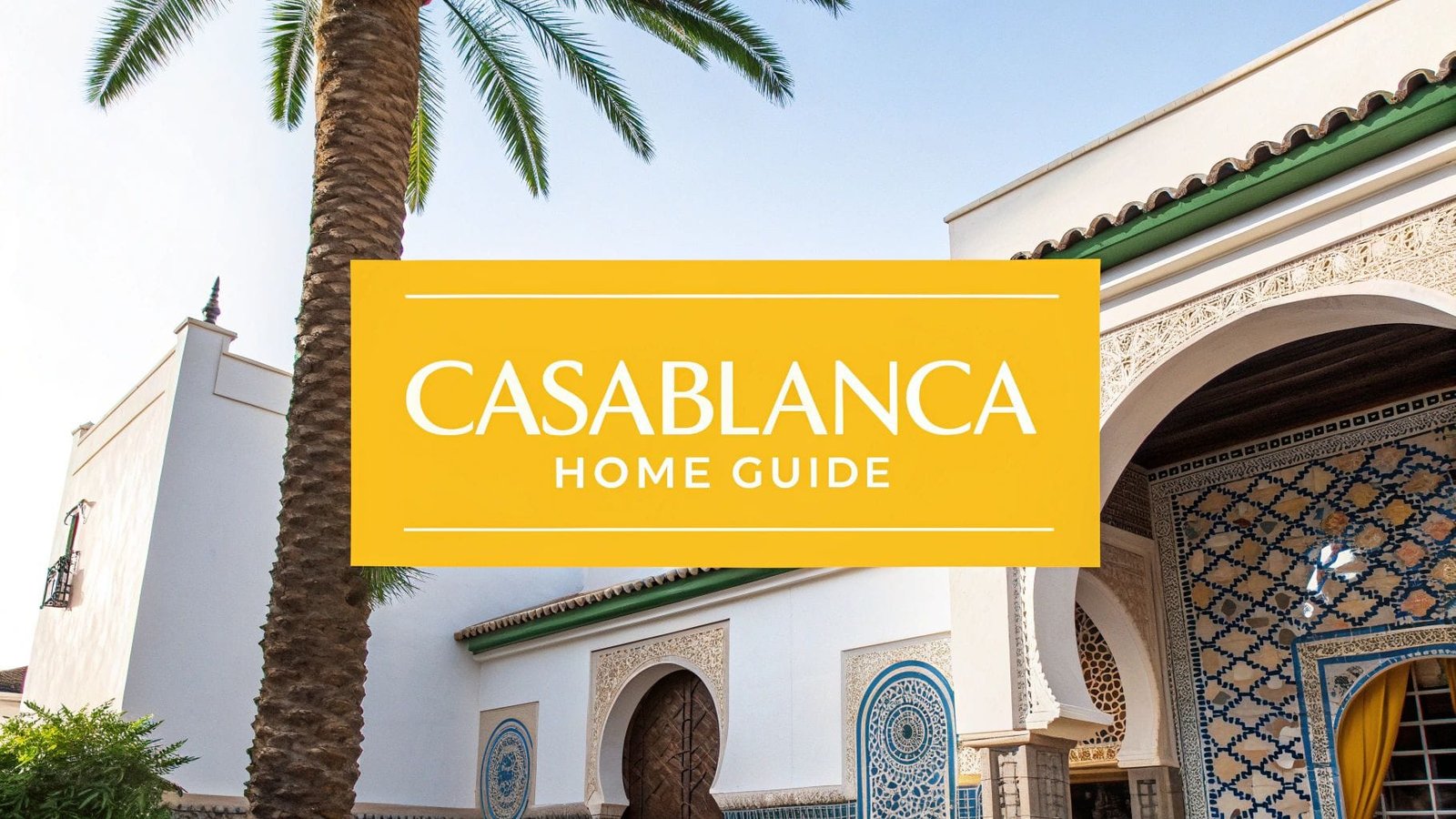
Finding the right maison a vendre Maroc Casablanca is about more than just scrolling through listings. You’re stepping into a dynamic and complex property landscape, one that’s uniquely Casablanca. This city is a real mosaic, where upscale districts sit alongside practical family neighbourhoods, each with its own vibe and investment potential.
Understanding The Casablanca Property Market
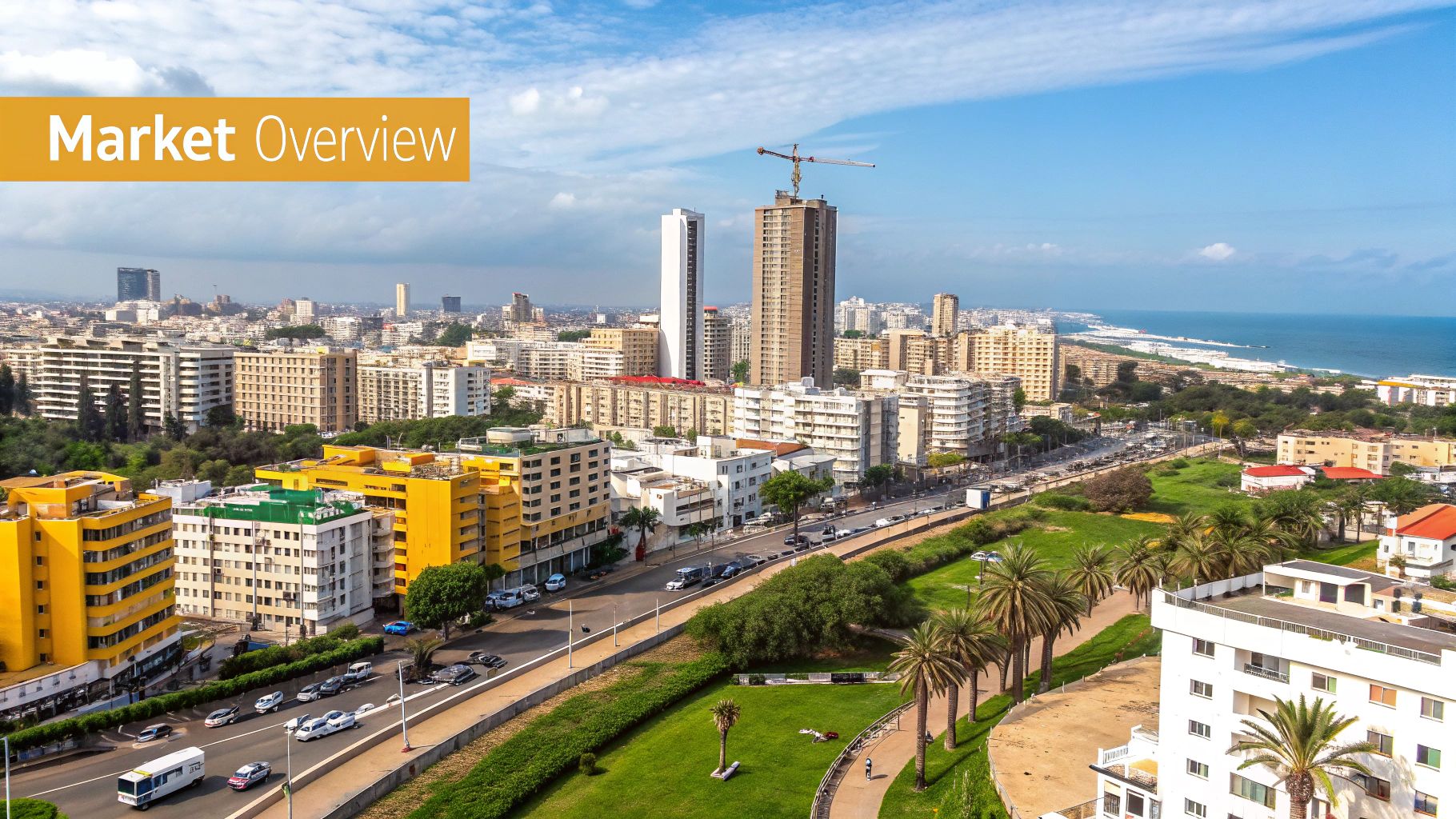
Starting your property search in Casablanca means diving into Morocco's economic engine. It’s a completely different world compared to Marrakech or Agadir, where tourism often dictates property values. Here, the market moves to the beat of business and finance.
Because Casablanca is a commercial hub, its real estate is focused squarely on primary homes for a growing population of professionals and their families. This creates a stable, if competitive, market. What you'll find is that local demand, economic health, and urban planning are the real drivers, not the ebb and flow of tourist seasons.
High-Demand Districts vs. Family-Oriented Neighbourhoods
Casablanca's property market is really a collection of micro-markets. Each district tells a different story and comes with a different price tag. Getting to know them is the essential first step in your search.
- Luxury and Prestige: Think Anfa Supérieur and Racine. These areas are the definition of upscale living, home to stunning villas, high-end apartments, and steps away from designer shops and exclusive clubs. Unsurprisingly, the price per square metre here is among the highest in the city.
- Modern and Professional: The development around Casablanca Finance City and the Sidi Maârouf business district has fuelled demand for sleek, convenient apartments. These zones are a magnet for professionals who want a short commute, modern comforts, and a vibrant, urban lifestyle.
- Family-Focused Suburbs: Neighbourhoods like Californie and CIL offer a welcome change of pace. They feel more suburban, with larger homes, more green space, and access to excellent international schools. They're perfect for families seeking a quieter base that’s still well-connected to the city.
For a closer look at what each area has to offer, our guide on real estate in Casablanca breaks it down even further.
The goal isn't just to find the "best" neighbourhood in Casablanca—it's to find the one that fits your life and financial picture. What’s perfect for a young professional is going to be completely different from what a growing family needs.
Economic Forces Shaping Property Values
Like any major city, Casablanca’s property market doesn't exist in a bubble. Big-picture economic factors, especially inflation and interest rates, have a real impact on both affordability and your potential return on investment. It's crucial to look past the sticker price.
The latest figures paint a very nuanced picture. While residential property prices posted a nominal increase, inflation has been eating into those gains. In the first quarter, for example, prices in Casablanca nudged up by 0.24% year-over-year. But when you factor in inflation, they actually declined by 1.34%. This is a perfect example of how your purchasing power can shift even when prices seem flat.
This environment means you have to be strategic. While certain sought-after areas will always hold their value due to strong demand, the broader market requires a sharp eye. Neighbourhoods with new infrastructure projects or those emerging as business hubs tend to see their values climb faster, making them smart bets for investment. Understanding these economic undercurrents gives you a huge advantage, helping you spot genuine opportunities and make a truly informed decision.
Building Your Property Wishlist and Budget
Diving into the search for a maison a vendre Maroc Casablanca without a clear plan is a surefire way to get overwhelmed. Before you even start scrolling through listings, taking the time to build a detailed wishlist and a rock-solid budget will save you countless hours and a lot of headaches. It helps you focus only on the properties that are a genuine fit for you.
This initial step is all about a frank conversation with yourself—balancing what you dream of with what you can realistically afford. It’s about defining your needs versus your wants and understanding the true financial picture.
Defining Your Ideal Property
Casablanca's property market is incredibly varied, with something for every kind of lifestyle. Are you a young professional who needs to be close to the action, or a growing family that values space and good schools? Your answer will likely guide you toward either a modern apartment or a spacious villa.
To narrow it down, think about these key factors:
- Property Type: Apartments are a practical and often more affordable choice, with building maintenance handled by a syndic. Villas, on the other hand, offer more privacy, gardens, and space, but you're responsible for all the upkeep.
- Location and Lifestyle: Do you crave the buzz of central neighbourhoods like Gauthier, or is the calmer, residential vibe of a place like Californie more your speed? Consider your daily commute, proximity to family, schools, parks, and your favourite cafés.
- Essential Features: I always advise clients to make two lists: ‘must-haves’ and ‘nice-to-haves’. A must-have could be three bedrooms or secure parking. A nice-to-have might be a balcony with a view or an open-plan kitchen. Be brutally honest here.
Doing this homework upfront stops you from falling for a beautiful home that just doesn't work for your actual life.
Calculating Your True Purchase Budget
This is where many first-time buyers get caught out. Your budget isn't just the sticker price of the property. The additional costs are significant, and ignoring them can put a massive strain on your finances down the line.
In Morocco, you should plan for these extra fees, known as closing costs, to add around 7-8% on top of the property's sale price. Here’s a quick breakdown of what that includes:
- Registration Tax (Droits d'Enregistrement): The biggest chunk, typically around 4% of the property value.
- Land Registry Fee (Conservation Foncière): This is about 1.5% and makes the ownership official.
- Notary Fees (Frais de Notaire): The notary handles all the legal paperwork, and their fee is usually between 1% and 1.5%.
This infographic gives you a clear picture of how the sale price is just one piece of the puzzle.
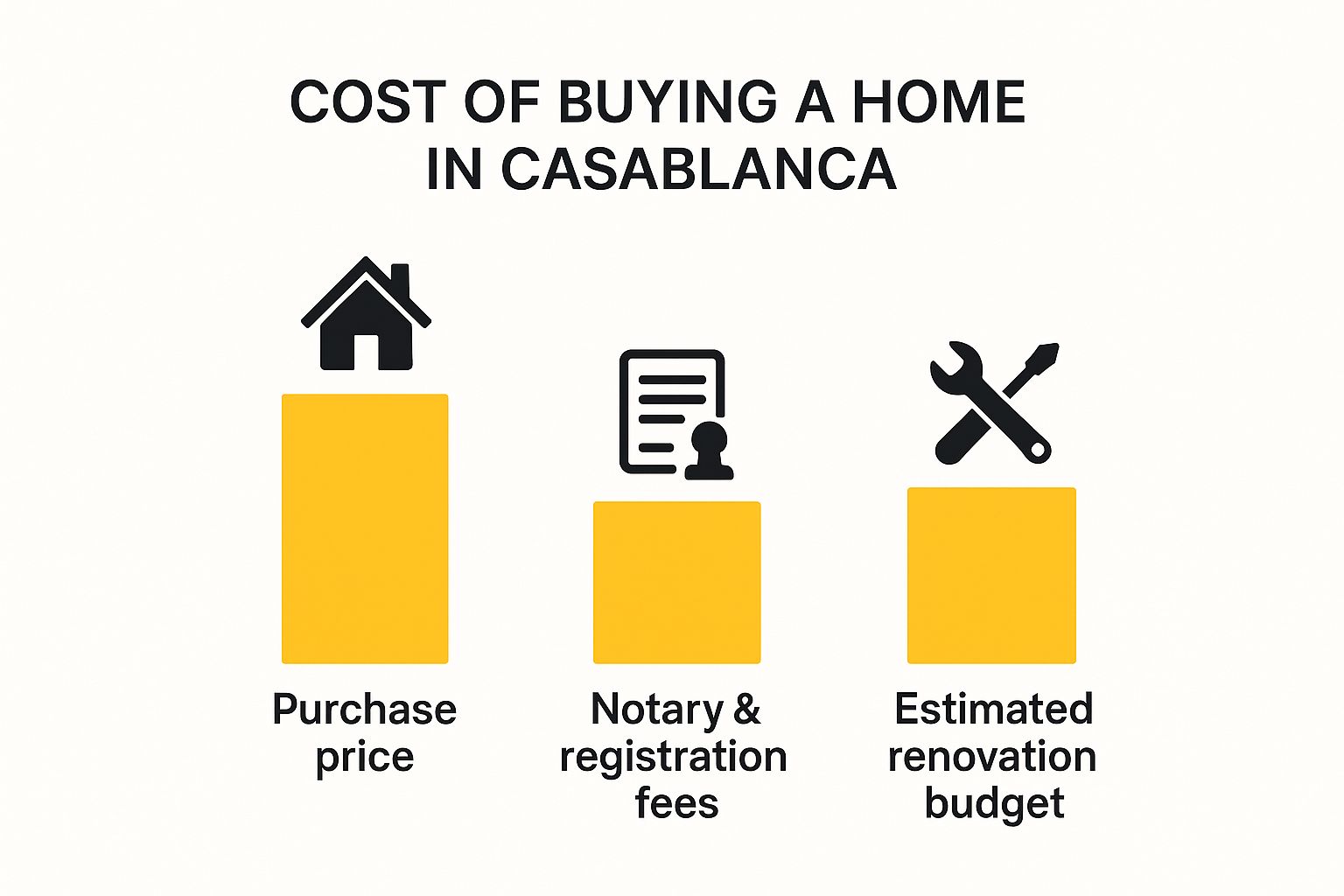
As you can see, things like taxes and potential renovation costs can seriously inflate your total initial investment. It’s crucial to factor these in from day one.
Think about it this way: you find what seems like a perfectly priced apartment for MAD 2,000,000. But once you add roughly MAD 150,000 (7.5%) in fees, the real cost is already MAD 2,150,000. If it also needs a new kitchen, that total climbs even higher.
Getting these numbers straight from the start means you’ll be looking at properties you can actually afford. For a more precise figure, I recommend using our property investment calculator to get a detailed breakdown of every expected cost. It turns a rough guess into a concrete budget, giving you the confidence you need to start your search for the perfect maison a vendre in Casablanca.
Mastering Your Property Search and Viewings
With your budget locked in and your wishlist ready, it’s time for the exciting part: the hunt for your new home in Casablanca. This isn't just about scrolling through listings; it’s about having a smart strategy that blends powerful online tools with the kind of on-the-ground knowledge only a local professional can provide.
Your search for a maison a vendre Maroc Casablanca will almost certainly begin online. Property portals like Mubawab and Avito are fantastic for getting a broad overview of the market. You can filter by neighbourhood, price, and size, giving you a realistic picture of what your budget can secure in different parts of the city.
But here’s a pro tip: don't stop there. Relying only on websites means you could miss out on prime off-market properties. A trusted local real estate agent, or agent immobilier, is your key to unlocking these hidden gems. They live and breathe the Casablanca market and often hear about properties before they ever hit the public listings.
How To Build An Effective Shortlist
Endless scrolling is a waste of your valuable time. The real skill is turning those countless online listings into a focused, high-potential shortlist. This means looking past the professionally staged photos and digging into the details.
Here’s how to filter listings like a seasoned buyer:
- Become a Map Expert: Don't just take the neighbourhood name at face value. Pin the property's exact location on a map. How long is the actual commute to your office? Where's the nearest tram stop or decent school?
- Read Between the Photos: What aren't they showing you? If there are no pictures of a particular room, the building's facade, or the common areas, that could be a subtle red flag.
- Gauge the Property's Age: The listing might not state the construction date, but the building's style often gives it away. An older property might have more character, but it also might come with a higher risk of renovation costs.
- Confirm Your Must-Haves: If you absolutely need secure parking or two full bathrooms, make sure it’s explicitly mentioned in the listing. Don't just assume it’s included.
This initial homework helps you build a powerful shortlist, ensuring every viewing you schedule is for a property that genuinely fits your needs. To get a feel for what’s currently available, feel free to browse our current real estate listings in Casablanca.
The Art Of The Property Viewing
A viewing is your chance to peel back the layers and see a property for what it truly is, beyond the polished online listing. It’s easy to get swept up in the moment, but you need to keep a critical eye out for potential problems that could become expensive headaches later.
In Casablanca, apartments are king. They represent about 66% of property searches, with two and three-bedroom layouts being particularly popular to accommodate local family life. This trend is driven by practicality and affordability when compared to villas. You can explore more about Moroccan property market perspectives for 2025 on agenz.ma to understand these dynamics better.
When you step inside a property, switch on all your senses. What do you see, hear, and even smell?
A fresh coat of paint can hide many secrets. Pay special attention to ceilings and the bottoms of walls for any signs of water damage, such as stains, bubbling paint, or a musty odour, which could indicate a serious plumbing or dampness issue.
Here is a practical checklist to run through during every viewing:
- Structural Health: Scan the walls and ceilings for any cracks, especially those that look long or jagged.
- Plumbing and Water Pressure: Don’t be shy. Turn on the taps in the kitchen and bathrooms to check the pressure. Flush the toilets.
- Electricals: Take a look at the fuse box—does it appear ancient? Flick a few light switches and test a socket or two.
- Windows and Doors: Open and close them. Do they seal properly, or can you feel a draft? Check for condensation between the panes.
- Neighbourhood Vibe: If you’re serious about a place, drive by at different times. A quiet street at 11 AM could be a traffic-clogged shortcut during evening rush hour. Listen for noise from neighbours or nearby cafes.
Approaching viewings with this level of detail transforms you from a casual looker into a truly informed buyer, giving you the confidence to make the right decision.
Popular Casablanca Neighborhoods at a Glance
Choosing the right neighbourhood is just as important as choosing the right house. Casablanca is a city of diverse districts, each with its own distinct character and price point.
To help you navigate your options, here’s a quick comparison of some of the most sought-after areas in the city.
| Neighborhood | Average Price (per m²) | Best For | Key Characteristics |
|---|---|---|---|
| Maârif | MAD 18,000 – 25,000 | Young professionals, shoppers, urban living | Central, bustling, great shopping, modern apartments |
| Anfa | MAD 25,000 – 40,000+ | Luxury seekers, families, expats | Upscale, sea views, villas and high-end residences, quiet |
| Gauthier | MAD 20,000 – 28,000 | Foodies, socialites, convenient living | Trendy cafes, restaurants, art galleries, vibrant nightlife |
| Bourgogne | MAD 16,000 – 22,000 | Families, value-conscious buyers | Residential, good amenities, mix of old and new buildings |
| Racine | MAD 22,000 – 30,000 | Fashion lovers, boutique shoppers | Chic boutiques, high-end stores, elegant Haussmann-style flats |
This table is just a starting point, of course. The best way to find your perfect fit is to spend some time in these neighbourhoods, walk the streets, and see which one truly feels like home.
Securing Your Financing and Making an Offer
You’ve sifted through countless listings, walked through several properties, and finally found the perfect maison a vendre Maroc Casablanca. Now, the real work begins. It’s time to shift gears from searching to securing, a phase where financial readiness meets strategic negotiation. This all starts with getting your mortgage sorted with a Moroccan bank.
Getting a mortgage approved here is all about presenting a clear and stable financial picture. Whether you're a local resident or buying from abroad, Moroccan banks need to see that you're a reliable borrower. Being organised right from the start can make a huge difference, often speeding up the whole approval process.
Assembling Your Mortgage Application
Moroccan banks will ask for a fairly standard set of documents to see if you qualify for a home loan. While the exact list can differ slightly from one bank to another, the core requirements are quite consistent. You're essentially building a financial profile to prove your credibility.
For both Moroccan residents and international buyers, you'll generally need to pull together the following:
- Proof of Identity: Your Moroccan ID card (CIN) or a valid passport.
- Proof of Income: Typically your last three payslips, your employment contract, and sometimes an official letter from your employer (attestation de travail).
- Bank Statements: Your last three to six months of statements to show a healthy and consistent cash flow.
- Property Details: A copy of the preliminary sales agreement, known as the compromis de vente, for the house you want to buy.
My advice? Have digital copies of these ready to go before you even start talking to banks. It shows you're serious and makes a great first impression.
Navigating The Offer and Negotiation
Once you have a pre-approval in hand or are confident about your financing, you're ready to make a formal offer. In Morocco, this isn't just a casual conversation; it leads to a legally significant document called the compromis de vente.
This preliminary sales agreement is a formal commitment binding both you and the seller. It locks in the price and sale conditions, essentially taking the property off the market while the notary handles all the final legal checks.
A rookie mistake I see all the time is treating the asking price as set in stone. The Casablanca market nearly always has some wiggle room. A well-researched offer, backed by recent sales data for similar properties in the area, puts you in a much stronger negotiating position.
Your offer needs to be competitive but also smart. Look at the local market dynamics. Has the property been sitting for a while? Are comparable homes selling for less? Use this data to build a case for your offer price. A good real estate agent is worth their weight in gold here—they can help you frame an offer that’s appealing to the seller without overstretching your budget.
Protecting Your Interests With Clauses Suspensives
The compromis de vente isn't just about the price; it’s your primary legal safeguard. This protection comes from including specific conditions known as clauses suspensives (suspensive clauses). These make the final sale dependent on certain conditions being met.
Think of these clauses as your escape hatches. If a condition isn't fulfilled, you can legally back out of the deal without losing your deposit. They are absolutely critical for protecting your investment.
Here are the non-negotiable clauses you must include:
- Securing Financing: This is the big one. The clause states the sale only goes through if you get your mortgage approved within a specific timeframe, usually 45 days. If the bank says no, you can walk away without any penalty.
- Clear Title: This condition ensures the notary confirms the property has a clean title (Titre Foncier). It must be completely free of any debts, liens, or claims from other parties.
- Building Permits and Conformity: This clause is crucial for verifying that all construction and any renovations have the proper permits, including the certificate of conformity (permis d’habiter). This stops you from accidentally buying a property with illegal additions.
By embedding these protections into your compromis de vente, you turn a simple agreement into a powerful legal shield. It ensures your Casablanca dream home doesn't become a financial nightmare and gives you the peace of mind to move forward with confidence.
Navigating the Legal Steps to Final Ownership
So, your offer has been accepted and the compromis de vente is signed. Congratulations! Now you’re entering the final, and arguably most critical, phase of buying your home. This part of the journey is less about back-and-forth negotiation and more about meticulous legal procedure, all orchestrated by one key person: the notary (notaire).
In Morocco, a notary isn't just someone who witnesses signatures. They are state-appointed officials whose role is far more substantial, acting as a neutral party to ensure the entire transaction is legally sound for both you and the seller. Think of them as the legal guardian of the deal.
The notary's main job is to protect your interests by performing exhaustive due diligence on the maison a vendre Maroc Casablanca you're about to buy. This is not a step to rush. They are there to make sure every document is in order before a single dirham is transferred or any final papers are signed.
The Notary’s Due Diligence Process
I often tell clients to think of the notary as a detective hired to investigate the property’s entire legal history. Their most important task is to conduct a detailed title search, a process known as recherche sur la conservation foncière. This is where they confirm, without a doubt, that the seller is the legitimate owner and has the full right to sell the property.
During this investigation, the notary will tick off several crucial checks:
- Title Verification: They pull the property’s title deed (Titre Foncier) to ensure it’s clean, undisputed, and legally sound.
- Lien and Debt Check: The notary confirms there are no outstanding mortgages, liens, or other legal claims against the property that could come back to haunt you later.
- Tax Compliance: They make sure all property-related taxes, like the taxe d’habitation and taxe de services communaux, are fully paid up by the seller right to the date of sale.
- Permit Confirmation: This is a big one. The notary verifies the existence of a valid building permit and a certificate of conformity (permis d’habiter), which confirms the property was built legally.
This entire process can take several weeks, and while it might test your patience, its importance is immense. It's your ultimate safeguard against future legal headaches and unwelcome financial surprises.
Understanding the Key Legal Documents
Once the notary has completed their checks and given the green light, they’ll prepare the final legal documents to officially transfer ownership. The star of the show here is the final deed of sale, or acte de vente. This is the definitive contract that, once signed, officially makes you the legal owner of the property.
The acte de vente is a detailed document that lays everything out in black and white, including:
- Full details of both you (the buyer) and the seller.
- A precise legal description of the property, including its official title number.
- The final agreed-upon purchase price and confirmation of the fund transfer.
- A declaration confirming the property is being transferred free of any liens or encumbrances.
Signing this document in the notary’s office is the final, culminating moment. It's when the deal becomes irreversible, and you finally get the keys to your new home in Casablanca.
A Transparent Breakdown of Closing Costs
To avoid any nasty shocks on closing day, you need to have a firm grasp on the closing costs. These fees are paid when you sign the acte de vente and are entirely separate from the property's price. You should budget for them to be around 7-8% of the total purchase value. Your notary will provide an itemised statement, but the costs generally break down like this.
| Fee Category | Description | Typical Percentage |
|---|---|---|
| Registration Tax (Droits d'enregistrement) | A government tax to officially register the sale. | 4% of the purchase price |
| Land Registry Fee (Conservation Foncière) | The fee for updating the land registry with your name. | 1.5% of the purchase price |
| Notary Fees (Frais de Notaire) | The notary's professional fee for their services. | 1% – 1.5% of the purchase price |
| Miscellaneous Fees | Minor administrative costs for certificates and stamps. | Usually a small fixed amount |
Budgeting for these costs from day one is non-negotiable. For a MAD 2,000,000 property, for instance, you should set aside an additional MAD 140,000 to MAD 160,000 just for these fees. Having that cash ready ensures a smooth, stress-free closing day.
Your Top Questions About Buying in Casablanca, Answered
When you start looking for a maison a vendre Maroc Casablanca, you’ll inevitably have questions. It’s a big move, and understanding the nuances of the local market is key to feeling confident. Let's tackle some of the most common queries I hear from buyers.
Apartment or Villa: Which One Is Right for You?
The classic Casablanca dilemma: apartment or villa? Honestly, it boils down to your lifestyle, budget, and how much hands-on maintenance you’re prepared for. The living experience and financial commitment for each are worlds apart.
Apartments are, by and large, the more practical and budget-friendly choice, especially if you want to be in the heart of the action. You'll have shared building fees, known as syndic fees, that cover the upkeep of common areas, security, and sometimes perks like a pool. This makes them a fantastic low-maintenance option for professionals or anyone who loves the idea of a "lock-up-and-go" home in lively districts like Maârif or Gauthier.
A villa, on the other hand, offers something apartments can't: expansive space, total privacy, and often a private garden—a true slice of luxury in a bustling city. That said, this freedom comes with a much higher price tag and the sole responsibility for all maintenance. From gardening and roof repairs to your own security system, it's all on you. You'll typically find beautiful villas in quieter, greener suburbs like Anfa Supérieur or Californie, which are perfect for families who value space over being in the city centre.
Can Foreigners Legally Buy Property in Casablanca?
Yes, absolutely. Foreign nationals can buy titled property in Moroccan cities, including Casablanca, without any major hurdles. This covers almost everything you’ll find on the market—apartments, modern villas, and renovated riads—as long as they have a formal land title, or Titre Foncier.
Once you purchase a titled property, you hold the exact same ownership rights as a Moroccan citizen, giving you a very secure legal foundation for your investment.
The one critical restriction you must know about is that foreigners are not permitted to buy agricultural land. This is important because some properties on the city's fringes may not have been officially rezoned for residential use. This is where your notary becomes indispensable; they will verify the property's legal classification during their due diligence to ensure you're in the clear.
What Are the Closing Costs I Should Budget For?
This is a big one. One of the easiest mistakes to make is to focus solely on the sticker price of the home and get blindsided by the additional fees needed to finalise the deal.
A good rule of thumb is to set aside an extra 7% to 8% of the property's purchase price to cover all your closing costs. This figure is a bundle of various taxes and professional fees.
Let’s break down what that percentage typically includes:
- Registration Tax (Droits d'Enregistrement): This is the biggest piece of the pie, usually around 4% of the sale price.
- Land Registry Fee (Conservation Foncière): This fee, which officially registers your name on the title, is about 1.5%.
- Notary Fee (Frais de Notaire): The notary's fee for handling all the legal paperwork generally lands between 1% and 1.5%.
To avoid any last-minute financial surprises, always ask your notary for a detailed cost estimate right at the start. It will make your budgeting process much smoother.
How Long Does the Purchase Process Take from Start to Finish?
While every deal is a little different, there's a typical timeframe you can anticipate for buying a home in Casablanca. From the moment your offer is accepted and you sign the preliminary sales agreement (compromis de vente) to getting the keys in your hand, you can generally expect the process to take between one and three months.
What causes the variation? The biggest factor is almost always financing. If you’re getting a mortgage, the bank's approval and paperwork can easily add several weeks to the timeline. A cash purchase, by contrast, is nearly always quicker.
Other things can also affect the schedule, like how efficiently the notary conducts the legal checks or if any unexpected issues pop up with the property's title or building permits. A clean, straightforward transaction between a prepared buyer and seller will almost always land on the shorter end of that one-to-three-month window.
At Rich Lion Properties, our goal is to make your property search in Morocco as smooth and successful as it can be. Discover how our expertise can help you find your perfect home.